The “Nasty Nine”…senior leadership traps (and how to move past them)
When it comes to complexity, creativity, innovation, collaboration & leading change in most enterprises, there is often a gap of awareness which results in textbook patterns of unnecessary suffering and permanent damage (mostly) for the people that leaders are responsible for leading. I refer to these frequently self-identified senior leadership traps as the “Nasty Nine”:
1) Weak leadership alignment around the things that matter most – vision, purpose and values (when the assumption of intellectual alignment is valued over emotional/spiritual alignment to the extent that it can be experienced by others as inauthentic or even dishonest)
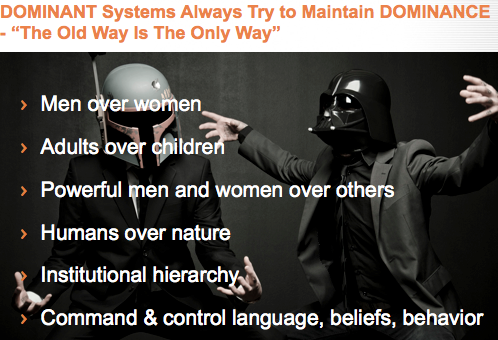
2) Historical attachment to old success formulas (lacking awareness and/or the courage to examine biases and pursue “new”, let alone let go of outdated leadership/business paradigms, because the leaders are actually benefitting from the attachment to the status quo – attached to what they know – attached to that imbalance of power – a preference for proof and reliability)
3) Bondage behind the leadership team’s current level of conscious transformation (when a critical mass of leaders are NOT seeking/shifting towards a more truthful, more effective identity system and (next level) world view, the operating system upgrade is delayed due to satisfaction with their own current level responses to circumstances…often mis-diagnosed as cultural resistance)
4) Inconsistent interdepartmental communication/collaboration and organizational silos/territorialism (valuing/prioritizing productivity and efficiency over the impact that meaningful relationships, inclusiveness and tolerance have on the effectiveness of large scale coordination of action…blindness to interdependencies and insularly focused rewards)
5) “Teaching to the Test” for Engagement (pursuing the symptomatic fixes of a Work/Life Balance myth due to a lack of understanding of the more complex implications of Self-Determination Theory, Theory of Planned Behavior, etc.)
6) Mandate/permission-driven culture (a preferred paternalistic belief that employees aren’t going to empower themselves – aka. “Teaching to the Test” for Empowerment)
7) Choice/time-constrained employees (aka. “learned helplessness” and the scarcity mindset)
8) Internally focused (lacking end-consumer understanding/empathy/ curiosity, lacking true desire for relationship with the end customer)
9) The Complexity Gap: (privileging simplicity when simplification is NOT good enough — for complex issues/opportunities we need to deeply understand and leverage the simple rules that drive complexity…Nick Obolensky from ComplexAdaptiveLeadership.com says.…added complexity is not necessary either, but the real trouble usually comes from trying to control complexity in an attempt to manage our discomfort with the feelings that come with our inability to appropriately respond to it)
Surprisingly most large companies (complex human systems) with an abundance of advantage and access to resources (e.g., talent, innovation tools, processes, data, algorithms, models), still tend to stumble over managing/leading a more strategic balance of unilateral control and mutual learning…the stumble nurtures the Nasty Nine. They stumble over competing polarities of operational mindsets (reliability vs eventuality; reactivity and creativity; past and future; ringleader and idea monkey; short term and long term; current level and next level) believed to be incompatible. They stumble over getting complexity and VUCA (volatility, uncertainty, complexity, ambiguity) to work for them and are often unaware that many of their responses to VUCA/complexity are working against them.
At the root of this gap and these traps, is the avoidance of focusing on and committing to the deep work of constant change within the “Individual internal” and “Collective Internal” – so the “next level” executives rarely show up, because that transformation is believed to be REALLY HARD to do…many (myself included) feel more comfortable driving change from the “Individual External” (e.g., skills, behavior, performance) and “Collective External” (e.g., org design, structure, workflow, systems, policies, SOPs)….as described by Bob Anderson/Ken Wilber’s four quadrants.
For the sake of better business outcomes, more and more often, senior executives and their corporate environments are awakening to these self-imposed traps and choosing new, “next level” training/innovation leadership programs that help them more effectively get to the complex problem solving by focusing on the long game…the deep work of transformation. No longer trapped by the Nasty Nine, they move forward to what’s next.
9 logo credit to Filip Lichtneker



 INNOVATION LEADERSHIP